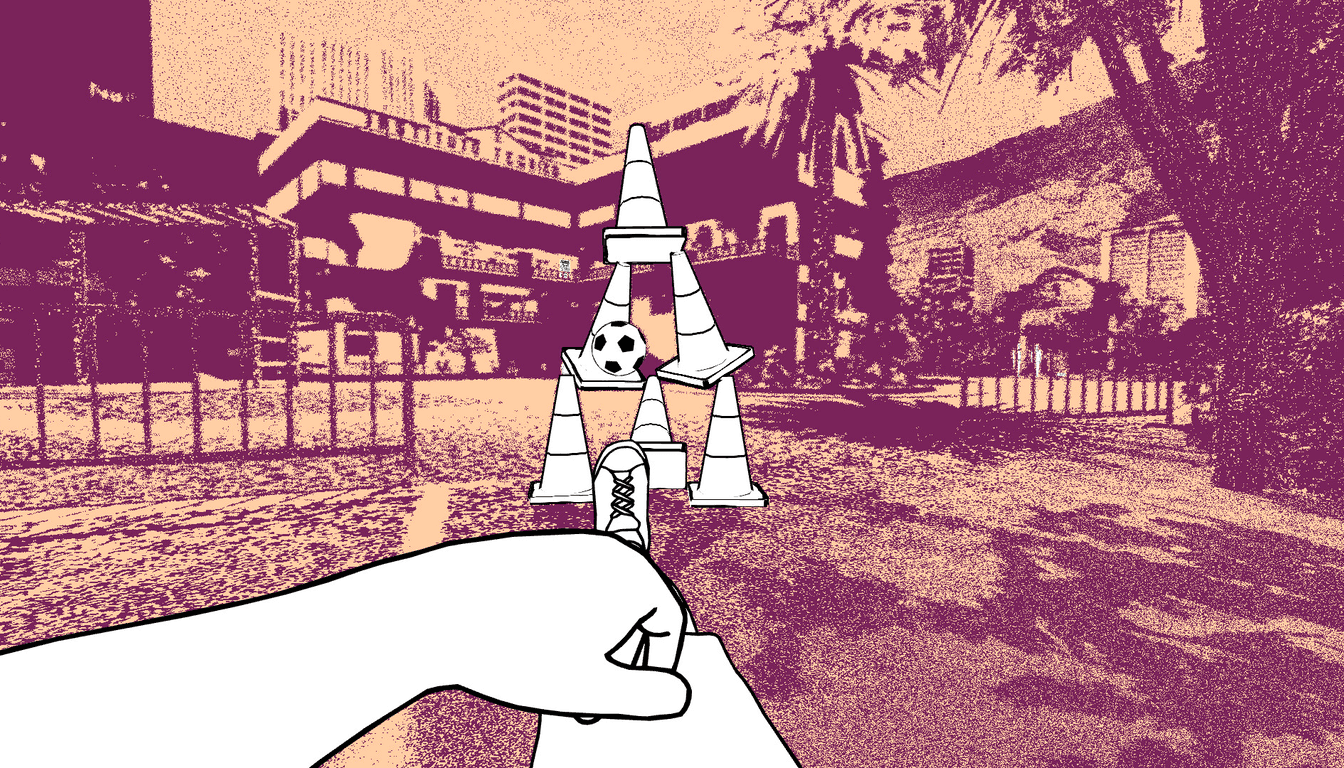
In Despelote, you start with a sound before an image: the acute whine of a CRT turning on, that high-frequency click as the tube warms up. Then the raspy low fidelity of the TV itself, and Tino Tini's Soccer 99 fades in under it. A tinny referee's whistle. A stadium hum sampled thin. You're holding a controller, kicking a pixelated ball, and the audio feels like it's coming out of a speaker three feet from your face because it is.
Footsteps somewhere behind you. Then voices. Your parents are in the kitchen, talking about what to make for dinner today, the cadence of people who've had this conversation a thousand times. The game keeps going. The match on the little screen keeps going. You half-listen to both.
The camera starts pulling back, slowly. You don't notice it until you realize the Tino Tini field is smaller than it was a second ago. The boy holding the controller loses focus at the same time you do. The game doesn't pause, exactly, it just stops being the center of the room. The parents are still talking. One of them remembers what day it is. There's a match today. The real one. They switch the channel.
Tino Tini is gone. Ecuador is on the screen.
You watch. An almost-goal. The stadium inhales, the commentators go up an octave, and in the kitchen your parents stop mid-sentence to look. You're hearing two layers of commentary now: the broadcast, and the parents reacting to the broadcast, overlapping. Ecuador has a real chance at qualifying. The house knows it.
Then the goal. The stadium erupts. The broadcast goes to pure noise. In the room, slight cheering. One of your parents says something about it being a great goal, the other agrees. You're more locked in than they are. The stadium is still roaring on the screen and you haven't looked away.
The broadcast takes the room. The game properly begins.
Despelote was made by Julián Cordero and Sebastián Valbuena, released in 2025. It's set in Quito during Ecuador's 2002 World Cup qualification, told from the perspective of an eight-year-old boy kicking a ball around his neighborhood. That's what it's about. What it does is harder to describe, and it starts doing it before you've moved the camera.
Before you see Ecuador play Peru, you play Ecuador against Peru in Tino Tini. Before you see Quito, you see a simulation of Quito. And underneath all of it, the thing the game is actually built from: a memory of a televised match inside a living room.
What you do in the game, mostly, is kick a ball. You walk a handful of streets. You kick against a wall, at a cone, at a friend, at nothing. The rest is overhearing — adults on inflation, classmates arguing about whether a goal was valid, a wedding where a TV gets hauled into the middle of the reception because otherwise the guests would leave to go watch the qualifier. You pick up fragments because you happen to be nearby, the way an eight-year-old picks up adult conversations by walking past them on the way to something more interesting.
Your attention slips. At breakfast you're looking at your eggs, and then you're not, and then you're in an empty field kicking the ball for what feels like miles. The game lets you be there as long as you want. Eventually you come back and the eggs are still there.
The way the game looks is the way a memory looks. Most of the world is rendered in a blurry, dual-tone style, photogrammetry of real Quito smeared into soft shapes. A dumpster is a blur. A building down the street is a blur. A person's face across the park is a blur.
But the ball is crisp and hand-drawn and brilliant white. Your hands and legs are hand-drawn. Your parents' faces are sharp. The old man who yells at you in the park is sharp. Your transformer toys are sharp.
The things you remember are drawn. The things you don't are fog.
Late in the game, you once again boot up Tino Tini's Soccer 99. The referee blows the whistle. The teams line up. The match should end.
It doesn't. The players keep moving, and you, as the tiny pixel sprite, walk out of the stadium. You cross a top-down Quito, past buildings you've only seen from eye level, and enter the protagonist's house. A simulation nested inside the memory has started reproducing the memory that contains it.
It's not long. It's not explained.
One of the game's last sequences puts you back in a classroom. You're staring out the window, halfheartedly circling answers on a school quiz. It's one of the first places the game showed you. You've been here before.
This time Cordero's voice comes over it.
He says he wishes he remembered the final day of the qualifying run better. He says he was four years old when Ecuador drew Uruguay and went through, not eight. He says he aged the character up so the story would make a little more sense, so it could hold together as something you play.
The Quito in the game is not the Quito he grew up in. The boy holding the controller is not the boy he was.
You finish the quiz. The bell rings. You sprint down the stairs and out onto the field because you know, without being told, that the thing you're going to do is kick the ball. You line up the shot. You kick.
And the world goes blinding color.
It's Quito. The real one. Not the dual-tone memory Quito, but a 2024 3D scan, fully lit, slightly melted at the edges. Cars blend into pavement. The stadium is fused to the ground in an unsettled, uncanny capture. It's a park but it's also a pile of mesh.
Cordero says they scanned it in 2024. He says it changed a lot after the qualifying run, but the physical changes are nothing compared to the changes in him.
He says when they came to record the sound of the park, they had to hire a security guard to protect the recording equipment.
The parents in the game are voiced by Cordero's parents. They improvised their dialogue from memories and scenarios Cordero gave them.
Cordero said in an interview that his parents have since divorced.
The family the recording preserves does not exist.
Cordero says they tried every way of depicting the moment Ecuador qualified. Every angle, every framing. Nothing matched it. So he gives up, and shows you the real thing.
The actual broadcast. The footage as it aired on Ecuadorian TV, the only clip Cordero could find of the first time Ecuador had ever qualified for a World Cup.
A string of different commercials runs over the top of it, one after another, because that's what the surviving clip had. The national memory of the national triumph comes with commercials laid across it. This is the copy that made it into the game.
Here is where, on the usual picture, the map eats the territory. The record survives, the recorded thing goes, and at some point the record stops being a record of the thing and becomes what the thing is. You cannot remember around the map anymore. The map has taken the territory's place and now answers to its name.
The old warning has been around for almost a century — Alfred Korzybski, 1931. The map is not the territory. The word tree is not a tree, the sentence about the battle is not the battle, every description is a reduction of the thing it describes. The warning comes with its own geography. On one side, the territory, the world as it actually was before anyone tried to get it down. On the other, the map, thinner and later. And it comes with an order: first the territory, then the map, and then, if no one is careful, the map wins.
Despelote does not give us that order. The only surviving footage of the goal came with commercials laid over it; whatever happened in that stadium in 2001 was, by the time anyone went looking for it, only reachable as a thing interrupted by ads. The childhood was four years old when the game needed it to be eight, and the only 2001 Quito anyone could scan was 2024 Quito with a few old photographs laid over it. There is no clean original sitting behind the game waiting to be recovered. The stadium, the city, the childhood existed. None survived in a form the game could reach. Perception was already a map, memory a map of a map, and the tape is only where that becomes impossible to pretend away.
Baudrillard gives the image four lives in Simulacra and Simulation. It reflects a profound reality; it masks and distorts that reality; it masks the absence of that reality; and finally it bears no relation to reality at all. By stage four, the image refers only to other images. It has become its own thing.
Stage three is the one that matters here. The image is no longer a lie about a thing; it covers for the fact that the thing is gone. By stage four, the cover no longer needs the absence. It circulates on its own. Baudrillard's tone is diagnostic, sometimes apocalyptic. Something has gone wrong. The culture has lost its grip.
Despelote lives in stage three but keeps looking toward the fourth. It does something Baudrillard's sequence does not expect. It turns and shows you the hinge. The surviving recording comes with the commercials attached. The scan gives Cordero 2024 Quito, already changed. Before the game ends, he admits in voiceover that he aged the child up.
The image points at the absence and says so, out loud, in a voiceover, while dissolving its own rendered world into raw scan data. The confession is the craft.
And the thing the confession releases you into is not grief. What Cordero has made instead, a map that knows it is a map and points at the shape of what isn't there, is the kind of thing a recorded memory was ever going to be.
This is the turn. Stage three is the condition. What the artist does with it is the decision.
But a city cannot object to its reconstruction. A person might. Once there is no clean original to recover, who gets to author the version that survives?
Goodbye, Eri opens on a boy's twelfth birthday. He is filming himself with the phone he has just been given.
The framing is crooked, held at a child's height. His mother asks him to use the phone to record her. She is dying. She wants him to keep filming until she is gone, so he'll have something to remember her by.
So he does. We watch this across dozens of pages, in four wide panels stacked down each page. The aquarium. Dinner. His parents asleep. His father crying where he thinks the camera cannot see him. His mother spends more time in the hospital. The phone fills up. The footage moves to a computer. Yuta keeps filming.
Then his father tells him it is time. His mother is dying, and she wants him to record her final breath. They walk toward the hospital. Yuta turns and runs.
The perspective changes. We see him from outside, sprinting away.
The hospital explodes behind him.
Not metaphorically. Full page, fire and debris, the building coming apart. He does not look back.
Then the frame pulls back. Dead Explosion Mother, directed by Yuta, is screening at school.
It's the movie he made. We've just watched it.
The audience sits lit by the projector, staring. The students call it garbage, disrespectful, a joke. A teacher takes him aside and asks what he thought he was doing. Yuta leaves.
He goes to the roof of the hospital his mother died in. He climbs onto the railing. A girl stops him.
Goodbye, Eri was made by Tatsuki Fujimoto and released as a one-shot in 2022. It's about two hundred pages long, most of them drawn as a fixed four-panel grid.
Most pages stack four wide panels, each shaped like a frame of phone footage. Read vertically, they resemble a strip of film running down the page. Yuta's movie was shot on a phone. The manga is drawn so that nearly every panel might belong to what he filmed. You are not simply watching Yuta make a movie. Much of the time, you are inside the movie.
The grid never breaks until it has a reason to. When it breaks, you feel it.
What the manga is, mostly, is a boy making movies. After the screening and the rooftop, Eri, a film obsessive with a room full of DVDs in an abandoned building, tells him she loved the way his first movie blurred fact and fiction, even if the movie itself frustrated her. She tells him to make another one. They watch movies until he learns how, then begin one together, Yuta behind the camera and Eri in front of it. She's sick too, though he doesn't know that yet, or he knows and pretends not to.
The second movie is theirs.
They decide early that it will be a semi-documentary about themselves with what Yuta's father, offhand, calls a pinch of fantasy. Yuta supplies it. He makes Eri a vampire. Later, when she asks him why, he tells her the film needed one.
That's the move the manga makes in the open. The fiction isn't buried under the record, it's planted in it, on purpose, with the person being filmed in on the construction. The film is not pretending to be a recording of Eri. The film is a thing Yuta and Eri are making, together, about themselves, which they are allowed to make whatever they need it to be.
Eri's illness breaks through mid-production. She gets really sick. Yuta stalls.
It's his father who unsticks him, and his father who tells him, in the same conversation, what his mother was actually like. She wasn't the woman his film had made of her. She was abusive. The scenes Yuta treasured were a woman who knew the camera was running, performing the mother she wanted to be remembered as in case she didn't make it. The footage didn't lie. It caught what she was willing to be on camera.
Yuta already knew. He'd known and filed it somewhere he didn't have to look. The father saying it out loud makes the knowing unfileable.
The mother in the film and the mother who raised him were not the same woman. There wasn't a kinder one underneath the edit waiting to be recovered. The edit is where Yuta makes her kindness continuous. She wanted to author how she would be remembered. He authored the version that survived.
He finishes the second movie. By the time it screens, Eri has died. This time the room sits with it.
Afterward, one of Eri's friends finds him and tells him, gently, that the Eri in the movie wasn't Eri. She was softer on screen than she was in life. Yuta nods. He knew.
The friend's Eri is another map. She keeps the filmed Eri from closing over her completely. The film is where Eri got to be the version she and Yuta wanted her to be. This time the authorship is shared and left in the picture. The vampire is right there in the room with them, written in, acted out, left visible. The pinch of fantasy was the whole practice.
Years pass. Yuta loses his own family in a car crash. He goes back to the abandoned building to kill himself. He goes where he went the first time, and for the same reason.
Eri is there. Eri has not aged.
The Eri he finds tells him she's a vampire. She tells him her brain dies every two hundred years and she starts over, and the movie they made together was the thing she left for herself so she'd know who she used to be.
The manga does not tell us whether this is true. The girl Yuta cast as a vampire in a movie about her own life is, at the end of that movie, telling us she really is one. We can't tell whether she is, whether Yuta is adding one last pinch of fantasy to his own life because he needs an ending he can walk out of, or whether the whole thing we've been reading was the film the entire time.
The manga refuses to pick. It makes the refusal the point.
Yuta walks out. Behind him, the building explodes.
We have seen this composition before. Fire and debris, the building coming apart, an older Yuta walking away. It rhymes with the shot that ended Dead Explosion Mother.
A shot is not a rhyme the first time. The second time, it is. The ending of Yuta's story is quoting the ending of Yuta's first movie, which means Yuta's life is the kind of thing that can be quoted. Which means the thing we have been reading was, on some level we cannot pin down, a movie the whole time. The pinch of fantasy turns out not to have been a pinch.
There is no ungrieved mother waiting under the one on the tapes, no un-fictionalized Eri under the vampire, no final version that settles the others. The father's account displaces the mother on film. The friend's account displaces Eri. Neither correction becomes the original. Each new map shows you what the last one left out, then becomes another map itself.
This is where Goodbye, Eri crosses into stage four. Every apparent correction arrives as another image inside a work that may itself be a film. The maps stop pointing back and begin pointing at each other.
Baudrillard stops there. But the maps keep failing, and they keep failing in the same direction. They leave a pressure behind, the sense of people none of the pictures can contain. The territory is that pressure, the failure shared by every version.
The footage is where they remain. Where they were is gone.
The title of this essay is a horror story. For the map to eat the territory, the territory has to be there first, whole and waiting to be swallowed. Neither of these works can produce that victim. Cordero reaches for 2001 and finds a tape with commercials on it and a memory that was four when the story needed it to be eight. Yuta reaches for his mother and finds a woman performing for the lens.
The grief in both works is real, but watch where it lands. Cordero's voiceover doesn't mourn Quito. The city is still there; the game's final scene is made from its 2024 scan. It mourns the childhood as it actually happened, before anyone tried to get it down, and that version of the childhood is the one thing that never existed. Yuta's first film mourns a mother nobody had. The wound is the reaching, toward something that was never on the other side.
What the two works do about it is the same thing. They sign the map. Cordero puts the confession in the game's own voice while the rendered world falls apart into scan data. Yuta writes the vampire in and leaves her visible. Neither pretends its material was ever territory. They work with what maps are made of, and they say so inside the work.
Fujimoto has said the line he built Look Back around wasn't his. He came across it in a book, in passing, and kept it:
Reconciliation with death can only happen through creation.
It doesn't claim the film brings anyone back. It claims the making is where the reconciling happens at all, because there was never an unmediated version to go back and settle with.
The map was never eating anything. It was the only kind of keeping there ever was.
Pretty cool right?