spring'84
Designed a successor web protocol and shipped its reader, publisher, and server: Ed25519-signed HTML boards, verified mutual links, sandboxed rendering, and an editorial rack UI.
Description
Spring '84 is a protocol and client for small, expressive, self-certifying web boards. It is also a direct successor to my implementation of Robin Sloan's Spring '83, which was one of those projects I kept thinking about after I was done with it. I liked the shape of the idea too much to leave it as a one-off experiment, but I also did not want to simply implement the original protocol again. Spring '84 became a second iteration: a response to Spring '83 in the spirit of Robin Sloan's request for friendly critique and comment, and a chance to specify my own successor to a protocol I loved.
It keeps the parts that made Spring '83 stick with me: one board per key, no algorithmic feed, no tracking, pull-only reading, and the newspaper rack metaphor. Then it pushes the idea toward the things I wanted from a second version: more room for visual expression, signed links between boards, relay hints for discovery, and a client that makes the network feel like a place instead of just a pile of HTML.
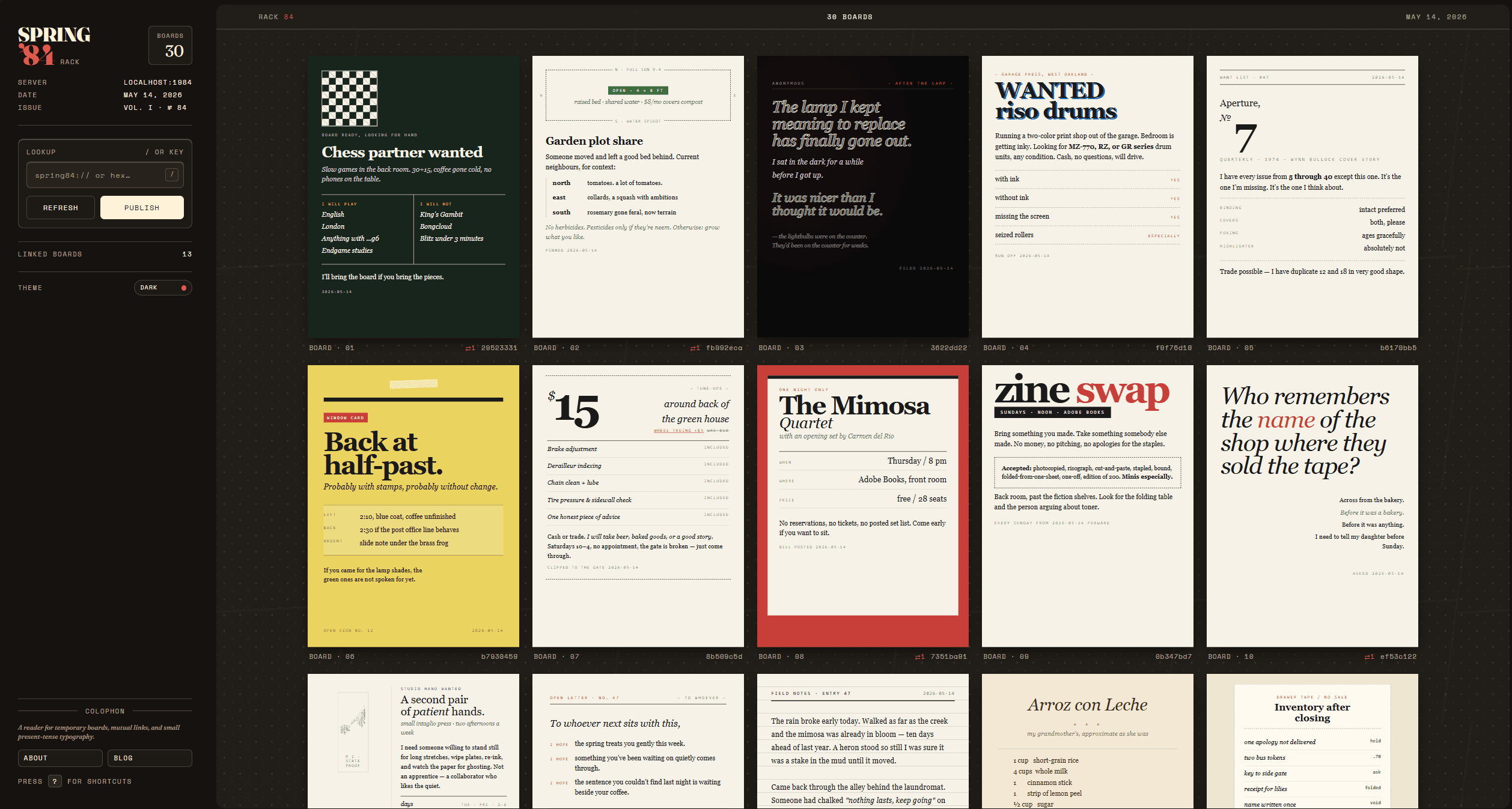
This project implements the complete reader and publisher loop. The app fetches keys from a server, validates and renders boards in a sandboxed iframe, verifies signatures, handles Spring '84 links, and includes a publishing modal for composing and signing new boards. The interface is shaped like a newspaper rack rather than a social feed: fixed-size boards, session shuffle, manual refresh, no accounts, no subscriptions, no hidden personalization.
Visually, I wanted it to feel editorial without becoming nostalgic decoration for its own sake. The UI uses a dark shell, warm paper surfaces, restrained red accents, and boards that look like small printed artifacts. A lot of the final work was not adding more features, but making the app feel coherent enough that the protocol's ideas were visible through the interface.
It keeps the parts that made Spring '83 stick with me: one board per key, no algorithmic feed, no tracking, pull-only reading, and the newspaper rack metaphor. Then it pushes the idea toward the things I wanted from a second version: more room for visual expression, signed links between boards, relay hints for discovery, and a client that makes the network feel like a place instead of just a pile of HTML.
This project implements the complete reader and publisher loop. The app fetches keys from a server, validates and renders boards in a sandboxed iframe, verifies signatures, handles Spring '84 links, and includes a publishing modal for composing and signing new boards. The interface is shaped like a newspaper rack rather than a social feed: fixed-size boards, session shuffle, manual refresh, no accounts, no subscriptions, no hidden personalization.
Visually, I wanted it to feel editorial without becoming nostalgic decoration for its own sake. The UI uses a dark shell, warm paper surfaces, restrained red accents, and boards that look like small printed artifacts. A lot of the final work was not adding more features, but making the app feel coherent enough that the protocol's ideas were visible through the interface.
Technologies
The client is built with React, Vite, TypeScript, Tailwind CSS, TanStack Router, CodeMirror, and a small internal Spring '84 client package. The backend uses Bun, Hono, Drizzle, and Postgres
The core protocol work is split into shared validation and client packages: key parsing, board validation, Ed25519 signature verification, Spring '84 URI rewriting, link verification, and publishing helpers. The web app consumes those packages instead of duplicating protocol rules in the UI.
The publish flow uses CodeMirror for the HTML editor, live preview in the same sandboxed board renderer used by the rack, in-memory private key handling, byte-budget validation, and image insertion that keeps boards within the protocol's size constraints.
The core protocol work is split into shared validation and client packages: key parsing, board validation, Ed25519 signature verification, Spring '84 URI rewriting, link verification, and publishing helpers. The web app consumes those packages instead of duplicating protocol rules in the UI.
The publish flow uses CodeMirror for the HTML editor, live preview in the same sandboxed board renderer used by the rack, in-memory private key handling, byte-budget validation, and image insertion that keeps boards within the protocol's size constraints.
Things Learned
I liked taking the time to specify how I thought the protocol should evolve instead of treating the implementation as the whole project. Spring '83 already had the core spark, but writing Spring '84 made me slow down and ask what I personally wanted from a successor: what should stay small, what deserved more room, and where the network needed a little more connective tissue to feel alive.
The UI is also miles ahead of my original Spring '83 implementation, which is always one of the most satisfying parts of revisiting an old idea. The first version proved I could build the thing. This version let me make it feel like something: a rack, a publisher, a small editorial surface, and a visual language that fits the protocol instead of just wrapping it.
The seed boards are a good example of that difference. They look much closer to the original vision I had for this kind of tiny web artifact, but Spring '83's board size made that vision hard to express. The constraint was useful, but it left very little room for visual texture. Spring '84 keeps the pressure of a small format while giving the boards enough space to actually have personality.
I also got to optimize my old keygen and modify a CUDA hash generator to grind harder Spring '84 keys.The best of which I got being 0000c3c690ca08fd6f071cfd6fb587efc10c9d5a81f1c7ce7c901066b84e1126. The key format is intentionally a small proof of commitment, and pushing the generator further made that part of the protocol feel much more real than if I had only written the validation code.
The UI is also miles ahead of my original Spring '83 implementation, which is always one of the most satisfying parts of revisiting an old idea. The first version proved I could build the thing. This version let me make it feel like something: a rack, a publisher, a small editorial surface, and a visual language that fits the protocol instead of just wrapping it.
The seed boards are a good example of that difference. They look much closer to the original vision I had for this kind of tiny web artifact, but Spring '83's board size made that vision hard to express. The constraint was useful, but it left very little room for visual texture. Spring '84 keeps the pressure of a small format while giving the boards enough space to actually have personality.
I also got to optimize my old keygen and modify a CUDA hash generator to grind harder Spring '84 keys.The best of which I got being 0000c3c690ca08fd6f071cfd6fb587efc10c9d5a81f1c7ce7c901066b84e1126. The key format is intentionally a small proof of commitment, and pushing the generator further made that part of the protocol feel much more real than if I had only written the validation code.